Gut Supplements for Horses – Do They Really Work?
With the huge number of gut supplements now available, it can be incredibly confusing to know what works, why it works, and whether your horse actually needs one.
Manufacturers make countless claims about their products. Some are based on good scientific research, while others rely more on marketing designed to pull at your heartstrings or leave you feeling that your horse can’t possibly be healthy without their supplement.
The best way to make an informed decision is to first understand how the horse’s digestive system works. Buying supplements without this basic knowledge often leads to wasted money, unnecessary supplementation, and an unbalanced diet.
What is an enzyme?
Enzymes are biologically active proteins that speed up chemical reactions. In digestion, they break down nutrients in feed into smaller molecules that can be absorbed and used by the horse.
Without enzymes, nutrients would not be efficiently digested or absorbed.
Below is a simple overview of where digestion occurs within the horse’s gastrointestinal tract (GIT).
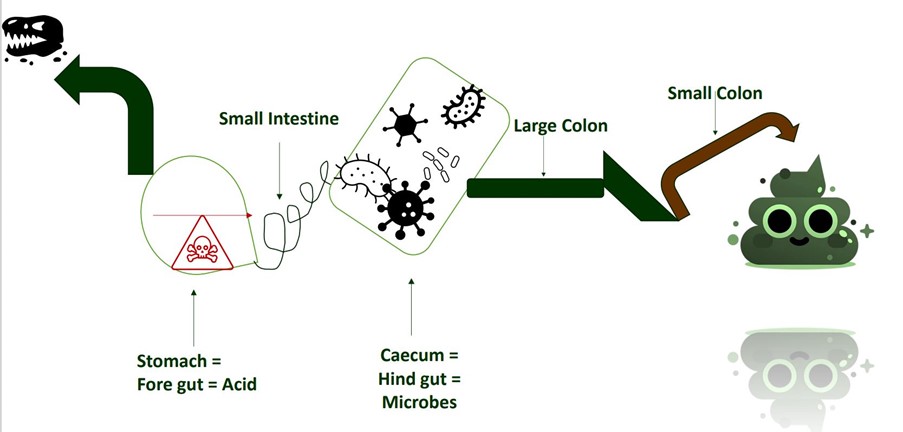
Stomach
The stomach produces hydrochloric acid (HCl) and digestive enzymes that begin breaking down protein and fats.
- Pepsin begins protein digestion.
- Gastric lipase begins fat digestion.
Small Intestine
The pancreas releases digestive enzymes into the small intestine where most digestion and absorption of nutrients occurs. These enzymes include:
- Amylase – digests starch.
- Proteases – digest proteins.
- Lipase – digests fats.
Most sugars, starches, proteins, fats, vitamins and minerals are absorbed here.
Caecum
The caecum houses billions of bacteria, fungi and protozoa, collectively known as the hindgut microbiome.
These microorganisms ferment structural carbohydrates (fibre) that the horse cannot digest on its own.
The fermentation process produces:
- Volatile fatty acids (VFAs), which provide a major source of energy.
- B vitamins.
- Some amino acids.
- Small amounts of gas.
Microorganisms also produce enzymes such as cellulases and xylanases, which help break down plant cell walls.
Large Colon
Fermentation continues in the large colon, producing additional volatile fatty acids that the horse uses for energy.
Small Colon
The small colon’s primary roles are water absorption and formation of faecal balls before manure is passed.
Why do horses need gut supplements?
The horse’s gastrointestinal tract is extremely sensitive and surprisingly easy to disrupt.
Common factors that negatively affect gut function include:
- Sudden changes in diet.
- Low fibre intake.
- High starch diets.
- Stress from travel, competition or illness.
- Dehydration.
- Certain medications, particularly antibiotics.
- Poor-quality forage.
Too little fibre
Horses are designed to eat almost continuously. Long periods without forage reduce saliva production and leave the stomach exposed to acid, increasing the risk of gastric ulcers.
Too much starch
Large starch meals can overwhelm the horse’s digestive capacity. When starch is not completely digested in the small intestine, excess starch passes into the caecum. There it is rapidly fermented by starch-loving bacteria, producing lactic acid and lowering hindgut pH.
This disruption of the microbial population can increase the risk of:
- Hindgut acidosis.
- Colic.
- Laminitis.
- Reduced fibre digestion.
- Poor nutrient utilisation.
Sudden feed changes
The hindgut microbiome is highly specialised. Different groups of microbes digest different feeds, so introducing new feeds requires time for the appropriate microbial populations to increase.
This adaptation usually takes 2–3 weeks, which is why all feed changes should be made gradually.
Dehydration
Dry feeds combined with inadequate water intake increase the risk of impaction, particularly within the caecum and large colon.
Gas produced during fermentation can also contribute to certain forms of colic.
Can digestive enzyme supplements help?
In some situations, yes.
Although horses naturally produce digestive enzymes such as pepsin, amylase and lipase, digestive efficiency can be compromised during periods of dietary change, stress, illness or when horses consume diets containing higher levels of starch than they are designed to process.
Supplementing selected digestive enzymes may improve nutrient digestibility and digestive efficiency in some horses, particularly when the supplement has been scientifically evaluated for its intended purpose.
However, digestive enzymes are not a cure-all, and they should never replace good feeding management.
Will any gut supplement work?
No. As a nutrition advisor, these are the questions I ask before recommending any digestive supplement.
Who produced the information?
Is it written by a qualified nutritionist, veterinarian or scientist?
Where was it published?
Is it published in a peer-reviewed scientific journal, or is it simply marketing on social media or a company website?
What evidence supports the claims?
Is the product supported by controlled research involving adequate numbers of horses, or only testimonials and anecdotes?
Is the research current?
Scientific knowledge continues to evolve, so more recent research is generally more reliable.
Has the finished product been tested?
Many supplements contain ingredients that have individually shown benefits.
However, once multiple ingredients are combined, they may interact differently. The finished product should ideally be tested as a whole, not just rely on research for each separate ingredient.
What problem are you trying to solve?
Before buying any gut supplement, ask yourself:
- Is my horse under significant competition or travel stress?
- Am I changing feed, pasture or hay?
- Has my horse recently been ill?
- Is my horse consuming a high-starch diet?
- Is forage quality poor?
- Has my horse been treated with medications that may have disrupted the gut microbiome?
Choosing a supplement should always begin with identifying the actual problem rather than simply buying the latest product on the shelf.
Common digestive enzymes found in supplements
Amylase
Helps digest starch and may improve starch utilisation when dietary starch intake is higher.
Xylanase
Breaks down hemicellulose within plant fibre, improving fibre digestion.
Cellulase
Helps break down cellulose in plant cell walls, potentially improving utilisation of forage.
Beta-glucanase
Breaks down beta-glucans, complex carbohydrates found in some cereal grains and yeasts. This may improve digestion of certain feed ingredients.
Phytase
Breaks down phytate, allowing phosphorus bound within plant material to become more available. It may also improve the digestibility of some minerals in grain-based diets.
The bottom line
Gut supplements certainly have a place, but they are not a substitute for good nutrition and management.
Before spending money on supplements, ensure your horse has:
- A balanced diet.
- Plenty of quality forage.
- Adequate water intake.
- Gradual feed changes.
- Appropriate starch intake.
- Correct vitamin and mineral balance.
Only then should you consider whether a digestive enzyme or gut supplement is likely to provide an additional benefit.
Remember, the goal isn’t simply to feed a gut supplement—it’s to identify what is actually limiting your horse’s digestive health and address that specific problem.
Selected research reading on horse gut enzyme supplementation:
Changes of the hindgut microbiota due to high-starch diet can be associated with behavioral stress response in horses. https://sci-hub.ru/https://www.sciencedirect.com/science/article/abs/pii/S0031938415003339?via%3Dihub Physiology & Behavior, 149, 159–164.
The Effect of Feeding Horses a High Fiber Diet With or Without Exogenous Fibrolytic Enzymes Supplementation on Nutrient Digestion, Blood Chemistry, Fecal Coliform Count, and In Vitro Fecal Fermentation https://www.sciencedirect.com/science/article/abs/pii/S0737080615004657
IFNM – Modulation of the equine microbiome by pasture and feed supplements: A metabolomics approach. https://www.researchgate.net/publication/335117686_Modulation_of_the_equine_microbiome_by_pasture_and_feed_supplements_A_metabolomics_approach
https://www.researchgate.net/publication/8491272_The_apparent_digestibility_of_phytate_phosphorus_and_the_influence_of_supplemental_phytase_in_horses
Examination of the use of exogenous α-amylase and amyloglucosidase to enhance starch digestion in the small intestine of the horse. https://sci-hub.ru/https://www.sciencedirect.com/science/article/pii/S0377840103002906 Animal Feed Science and Technology, 114(1-4), 295–305.
Visualization of the Anticaging Effect of Ronozyme WX Xylanase on Wheat Substrates. https://sci-hub.ru/https://onlinelibrary.wiley.com/doi/abs/10.1094/CCHEM-10-12-0130-R Cereal Chemistry Journal, 90(5), 439–444.
Exogenous fibrolytic enzymes improve carbohydrate digestion in exercising horses. chrome-extension://efaidnbmnnnibpcajpcglclefindmkaj/https://www.jafs.com.pl/pdf-118207-48761?filename=Exogenous%20fibrolytic.pdf Journal of Animal and Feed Sciences, 29, 35–45.
Happy Feeding!